What should happen after someone requests a SaaS demo

Alex AndersonFounder, Cultre
- PublishedOct 28, 2026
- Read11 min
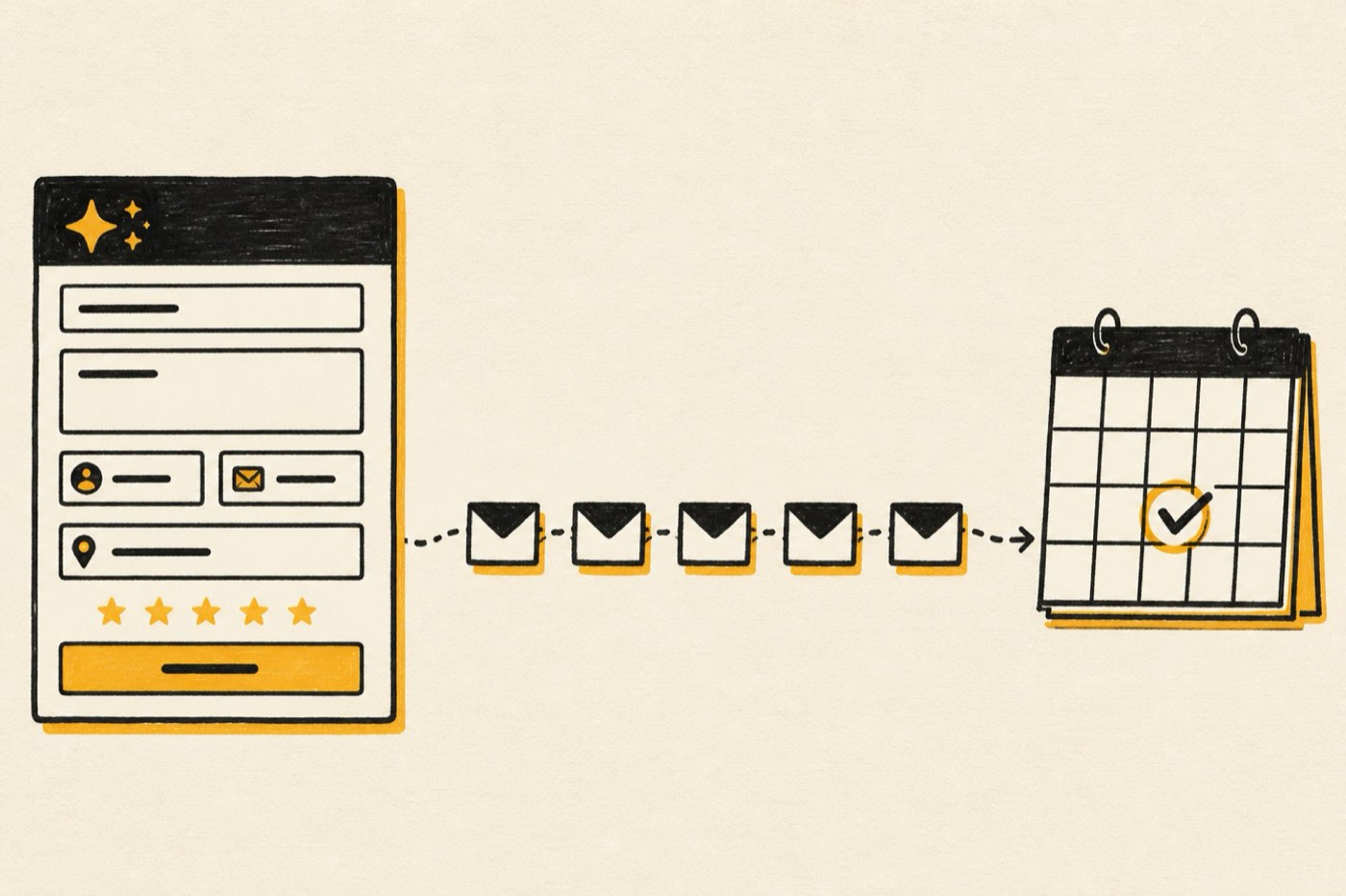
After someone requests a SaaS demo, three things should happen in order: a human-feeling confirmation within minutes, routing to the right rep with the context they need, and a short nurture sequence that prepares the buyer for the call or brings them back if they didn't book. Each email should do one job and earn the next open. That's the whole system.
Why the demo form is where most pipeline quietly dies
Picture a founder on a Monday morning looking at last month's numbers. Demo requests are up. Ad spend is up. Closed-won is flat. Somewhere between "Submit" and "first call," a good chunk of interested people simply evaporated, and nobody can say where they went.
We see this more than any other problem in SaaS marketing, and it almost never lives on the ad account or the landing page. It lives in the gap after the form. The buyer raised a hand, then got a generic "Thanks, we'll be in touch," a calendar link that went to the wrong person, and silence for two days.
Think of a busy restaurant on a Friday night. The demo form is the host stand. You'd never let a party stand there for 40 minutes without a word, a menu or an estimated wait. They'd walk across the street. Yet that's exactly what most demo flows do to a buyer who just told you they're interested.
So this article is about the host stand: what happens in the first five minutes, the first hour and the first two weeks after someone asks to see your product. (If your problem is that not enough people reach the form in the first place, start with our demo request page teardown instead.)
What should happen in the first five minutes?
The first five minutes decide whether the buyer feels received or processed. We use a simple three-step model for this window, which we call Confirm, Route, Reach.
- Confirm. The buyer gets an on-page confirmation and an email that says what happens next, who they'll talk to and when. Not "we'll be in touch." A name, a face if you have one, and a time.
- Route. The lead lands in the CRM with its source, the page they converted on and their answers, and gets assigned to one owner by rules, not by whoever checks the shared inbox first.
- Reach. The owner gets an instant alert with enough context to make a useful first touch, and the buyer gets a way to book right now if they're ready.
The best version collapses all three into one moment: the buyer submits the form and immediately sees a calendar for the right rep. Tools like HubSpot meetings, Chili Piper and Calendly routing all do some version of this. The tool matters less than the rule behind it.
How fast is fast enough for speed-to-lead?
Faster than you're doing it now, almost certainly. Research published in Harvard Business Review by James Oldroyd, Kristina McElheran and David Elkington, "The Short Life of Online Sales Leads", found that most companies are not responding to web leads nearly fast enough. The title says it well. Interest has a half-life.
The mechanism is simple once you see it from the buyer's side. When someone fills out a demo form, they are in the problem right now. They have a tab open, a pain they just felt and maybe two competitors' forms filled out too. An hour later they're in a meeting. A day later the urgency has drained back into the to-do list, and your rep is calling a person who has to remember why they wrote in.
Our working targets for a B2B SaaS team:
- Instant: confirmation email and a booking option (automated, no excuses)
- Under 5 minutes during business hours: a personal touch from the assigned rep (email, call or both)
- Same business day: a second attempt if the first got no answer
- After hours: an automated note that sets an honest expectation ("I'll reach out by 9am Pacific") and a calendar link
We dig into the staffing side of this, including what to do when you don't have an SDR team, in speed to lead for SaaS.
How should demo requests be routed?
Routing answers one question: who owns this person, starting now? If the answer is "the team," the answer is nobody.
Good routing is boring on purpose. Write the rules down before you touch the software:
| Signal | Route to | Why |
|---|---|---|
| Existing customer or open deal | Account owner | Nothing kills trust like a second rep pitching a current customer |
| Target account list match | Named account exec | They've likely been warming this account already |
| Company size or plan fit above threshold | AE directly | Skip the qualification step for obvious fits |
| Smaller or unclear fit | SDR or founder queue, round-robin | Qualify fast, don't make them wait for an AE |
| Student, competitor, job seeker, vendor | Polite auto-reply, no rep | Protects rep time without being rude |
Two habits keep routing honest. First, every routed lead carries its context: source, campaign, landing page and the buyer's own words from the form. Second, someone looks at unworked leads every day. A lead that was routed but never touched is worse than one that was never routed, because the dashboard says it's handled.
If you run paid search, this is also where you capture what Google needs to bid on real pipeline instead of form fills. We cover that loop in Google Ads for B2B SaaS.
What is a demo nurture sequence actually for?
A demo nurture sequence has two audiences, and most teams only write for one.
Track A: people who booked. They need to show up, show up prepared and show up with the right colleague. The enemy here is the no-show.
Track B: people who requested but didn't book, or booked and then no-showed. They need a reason to come back that isn't "just checking in." The enemy here is silence, followed by a guilt-trip email.
Both tracks run on the same principle, which is the heart of how we write these: every email does one job and earns the next open. If an email tries to confirm the meeting, share a case study, pitch a feature and ask for a referral, the reader learns that your emails are work. They stop opening. If each email is short, clearly useful and about them, they learn the opposite.
That principle is how we built a demo nurture sequence that hit a 71.6% open rate. The specific emails were written for one client's buyers, so we won't pretend you can copy them. The anatomy is portable, and that's what the rest of this article lays out.
The anatomy: five jobs in the right order
We map every demo nurture to five jobs. We call it the Confirm, Prepare, Prove, Unblock, Release sequence. Each job gets its own email, sometimes two, and they always run in this order because each one sets up the next.
- Confirm. Remove uncertainty. What happens, when, with whom.
- Prepare. Make the call better for them. A question to think about, a colleague to invite, a two-minute video so the demo can skip the basics.
- Prove. Show that someone like them got the result they want. One story, one outcome, one link.
- Unblock. Answer the objection that usually stalls deals at this stage: price, switching cost, security review, "we're not ready yet."
- Release. Give them a graceful exit. "Should I close this out?" emails get replies precisely because they respect the reader's time.
Notice what's missing: the feature tour. The demo is the feature tour. The emails exist to get the right person into the room in the right frame of mind.
Email-by-email template
Here's the template we start from. Timing assumes a weekday request; adjust for your sales cycle. Subject lines are patterns, not scripts. Write your own in your buyer's words.
| # | Track | When | Job | Subject line pattern | What's in it | One call to action |
|---|---|---|---|---|---|---|
| 1 | Both | Instantly | Confirm | "[Rep name] from [Company]: your demo" | Who they'll meet, what the call covers, booking link if not booked | Book or confirm the time |
| 2 | A (booked) | Day 0, within the hour | Prepare | A question about their situation | Two or three questions to think about so the call is about their problem | Reply with their answer, or invite a colleague |
| 3 | A (booked) | 24 hours before the call | Prepare | "Before we talk tomorrow" | A short video or one-page overview so the demo can skip the basics | Watch it (optional), keep the time |
| 4 | A (booked) | 1 hour before | Confirm | "See you at [time]" | Meeting link, rep name, one line on what they'll get | Join the call |
| 5 | B (not booked) | Day 1 | Prove | The outcome they're after, in their words | One customer story from a similar company, two or three sentences, link to more | Book a time |
| 6 | B (not booked) | Day 3 | Unblock | The objection, stated plainly | Straight answer to the most common stall at this stage | Reply with their question, or book |
| 7 | B (not booked) | Day 6 | Prepare | A useful resource, no pitch | A checklist, calculator or guide that helps even if they never buy | Use it; booking link in the P.S. |
| 8 | B, and A no-shows | Day 10 | Release | "Should I close this out?" | Short, plain, no guilt. Three options: book, not now, wrong person | Reply with one word |
A few rules that make this table work in practice:
- Exit on action. The moment someone books, they leave Track B and enter Track A. The moment they reply, a human takes over. Nothing erodes trust faster than an automated "just following up" landing after the buyer already answered.
- Send from a person. Rep name in the from field, plain-text-looking layout, a real reply-to address. Demo nurture is a conversation that happens to be automated, not a newsletter.
- One link, one ask. If an email has four buttons, it has zero priorities.
- Short beats clever. Most of these emails should be under 120 words. If it scrolls on a phone, cut it.
Why do some nurture emails get opened and others don't?
Open rates are mostly earned before the subject line. A buyer decides whether to open based on two things: who it's from, and what your last email was like. If the last one was useful and short, the next one gets opened almost on reputation alone.
That's the compounding effect behind a high open rate. Email 1 sets an expectation. Email 2 keeps it. By email 5, the reader opens because your name has become a signal of "this will take 30 seconds and help me." Break that promise once with a wall of text or a hard pitch, and the reputation resets.
Subject lines still matter, and the patterns we lean on are plain ones:
- Their problem, not your product. The buyer told you why they wrote in. Use it.
- Specific over clever. "Your demo with Sam on Thursday" beats a pun every time.
- Lowercase-casual is fine; clickbait is not. Curiosity gets one open. Trust gets all of them.
One honest caveat about the metric itself. Since Apple introduced Mail Privacy Protection, which stops senders from using invisible pixels to learn when someone reads a message, open rates have become a noisier signal across the industry. We treat opens as a check on subject-line fit and sender reputation, and judge the sequence by what it's for: replies, booked meetings, show rate and pipeline created.
How do you measure a demo nurture sequence?
Measure the sequence by the job it was hired to do. A table we use with clients:
| Stage | Metric | What it tells you |
|---|---|---|
| First five minutes | Time to first human touch | Whether Confirm, Route, Reach is working |
| Track A | Show rate | Whether Prepare emails are doing their job |
| Track A | Meetings with a second stakeholder | If the right people are in the room |
| Track B | Reply rate and booking rate | Whether Prove and Unblock are landing |
| Release email | Replies, including "not now" | If your pipeline is getting cleaned honestly |
| Whole flow | Pipeline created per demo request | The number your board actually cares about |
A "not now" reply is a good outcome. It tells your rep to stop chasing and tells your forecast the truth. A sequence that produces clean nos is worth more than one that produces silent maybes.
Common mistakes we fix most often
- The black-hole confirmation. "Thanks for your interest!" with no name, time or next step. Rewrite it first; it's the most-read email you'll ever send.
- Round-robin with no context. The rep calls with "So, what made you reach out?" when the buyer already wrote three sentences in the form.
- The newsletter disguised as nurture. Branded HTML templates, five links and a hero image. It reads like marketing because it is.
- No exit rules. Booked buyers still getting "Haven't heard from you!" emails.
- Nobody owns it. Marketing built the sequence, sales owns the leads, and nobody owns the handoff between them. Pick a name.
Where to start this week
If you only do three things:
- Rewrite the confirmation email with a name, a time and a booking link.
- Write your routing rules on one page, then check the CRM actually follows them.
- Add the Release email to every open demo request older than ten days.
That alone usually tells you more about where your pipeline is leaking than another month of ad tests. If you'd like a second set of eyes on your flow, this is exactly the kind of work in our services, and a 30-minute call is an easy place to start.
Questions people ask next.
How many emails should a demo nurture sequence have?
Enough to do the five jobs, and no more. For most SaaS teams that's three or four emails for people who booked and four or five for people who didn't, spread over about two weeks. If an email doesn't have a distinct job, cut it.
Should demo nurture emails be plain text or designed HTML?
Mostly plain text, or HTML that looks like plain text. These emails should feel like they came from a person, because the buyer is about to meet that person. Save designed templates for newsletters and product announcements.
What's a good open rate for a demo nurture sequence?
It depends on your list and your sender reputation, and since Apple's Mail Privacy Protection, opens are a noisy metric everywhere. Judge the sequence on reply rate, show rate and pipeline created. For reference, a demo nurture sequence we built reached a 71.6% open rate, but the principles behind it matter more than the number.
Who should own the demo nurture sequence, marketing or sales?
Marketing usually builds it and sales lives with the results, so name one owner for the handoff itself. In small teams that's often the founder or a single marketing lead who meets with sales weekly to review unworked leads and replies.
Can HubSpot run this whole flow?
Yes. HubSpot can handle the form, routing rules, meeting links, sequences and enrollment triggers that pull people out when they book or reply. The software is rarely the bottleneck. Clear routing rules and short, useful emails are.
Founder of Cultre in Redding, California. Fifteen years building marketing for software companies and local businesses, and the one who'll be on your call.
Alex