
How to get your SaaS recommended by ChatGPT

Alex AndersonFounder, Cultre
- PublishedOct 28, 2026
- Read14 min
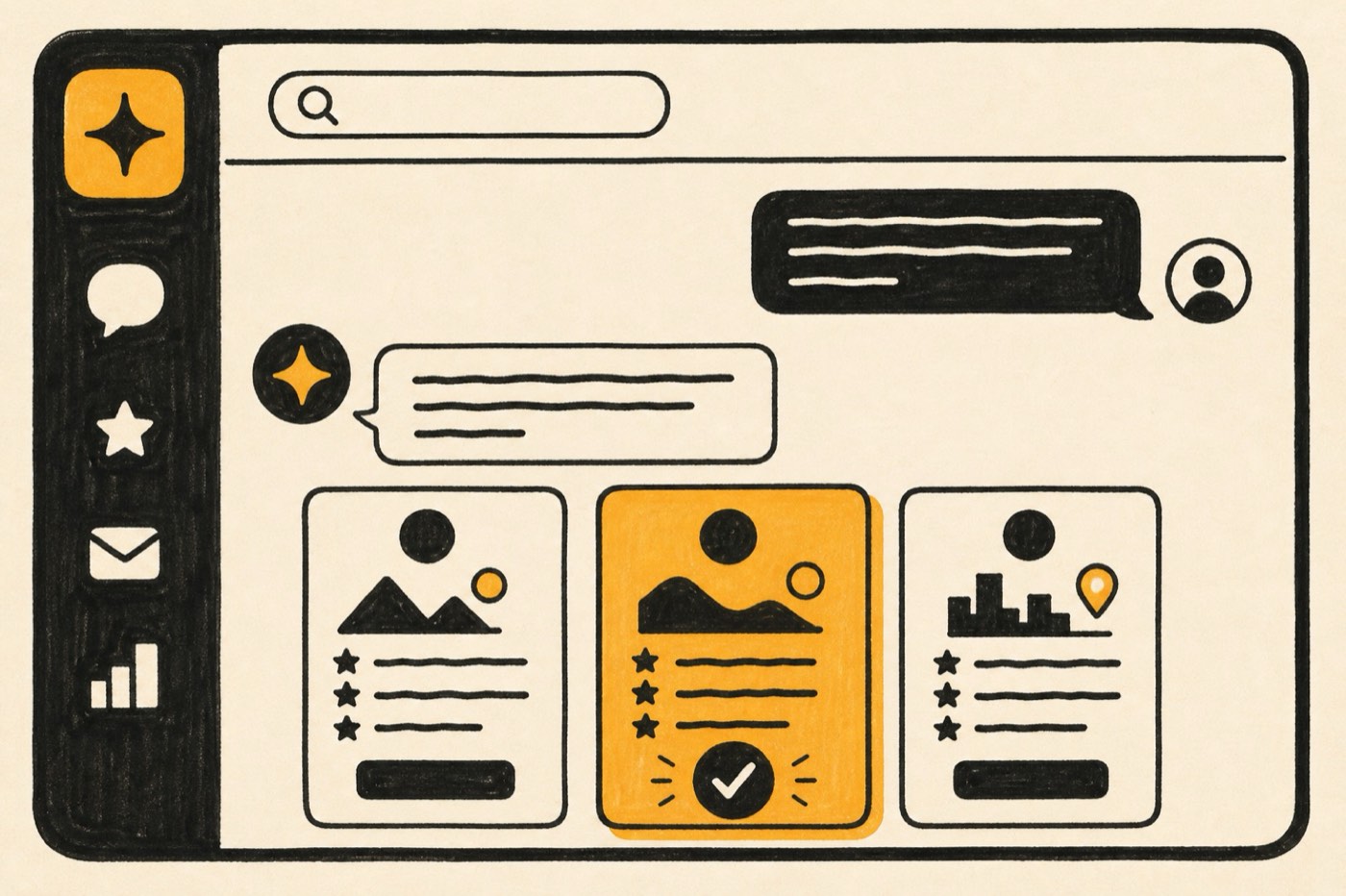
To get your SaaS recommended by ChatGPT, make your product easy for the AI to reach, read, describe and trust. That means letting its search crawler in, answering buyer questions plainly on your own pages, covering every comparison and use case a buyer asks about, keeping your product's identity consistent everywhere, and earning mentions on the review sites and communities the AI already cites.
Why does ChatGPT keep recommending your competitor?
Picture a founder on a Thursday night. Demo requests have been flat for a quarter, so she opens ChatGPT and types the question her buyers type: "What's the best scheduling software for a 40-person field service team?" Three names come back, with a tidy paragraph on each. Hers isn't one of them. One of the three launched two years after she did.
I've watched some version of that moment play out with a lot of software teams, and the first reaction is always the same: the AI is broken, or biased, or bought. It usually isn't. It's doing exactly what it was built to do, and that's the useful part, because a system you understand is a system you can work with.
Here's the mental model I use. Your brand is a house. ChatGPT is the realtor. For twenty years, buyers toured the open houses themselves: they searched, opened ten tabs and did the comparing. Now they describe what they want to a realtor who has already toured every listing in town, and she answers in one paragraph: "Look at these two." The buyer never sees the other ninety-eight.
The realtor isn't picking favorites. She shows the houses she could get into, could understand, could describe with confidence and has heard good things about. If your competitor keeps getting shown, their house is easier to show. That's fixable.
How does ChatGPT decide which software to recommend?
When someone asks ChatGPT a buying question, it usually doesn't answer from memory alone. It searches the web, pulls a handful of passages, and writes its answer with those passages open in front of it. Engineers call this retrieval. I call it the realtor checking her notes before she talks.
Two things about that process matter more than anything else for software companies.
First, one question becomes many searches. Google says plainly that its AI features may use a "query fan-out" technique, "issuing multiple related searches across subtopics and data sources" to build a response (Google Search Central). Expect ChatGPT search to work on the same principle. "Best scheduling software for field service" quietly becomes pricing for small teams, mobile dispatch, QuickBooks integration, reviews from HVAC companies, and "alternatives to" the category leader. Every one of those sub-searches is a room the realtor checks.
Second, the AI trusts the neighborhood more than your brochure. Ahrefs studied 75,000 brands and found the strongest correlation with being mentioned in Google's AI Overviews was branded web mentions (0.664), well ahead of backlinks (0.218) (Ahrefs). That's correlation, not proof of cause, but it matches what I see: what the web says about you outweighs what you say about yourself.
Put those together and the job gets clear. You need a house the realtor can get into, rooms for every question the buyer will ask, and neighbors who speak well of you.
The walkthrough: six things the realtor checks before she shows your product
This is the framework we use at Cultre, adapted from our AEO field guide for software teams specifically. Each step pairs a part of the house with the practice it stands for. Work them in order; the early ones are cheap and the late ones compound.
| Part of the house | What it means for your SaaS | Who usually owns it |
|---|---|---|
| 1. The front door | AI search crawlers can reach and read your pages | Your developer |
| 2. The floor plan | Pages are structured so passages can be lifted cleanly | Dev + content |
| 3. The rooms | A page for every sub-question: pricing, comparisons, use cases, integrations | Product marketing |
| 4. The windows | Answer-first copy the AI can quote word for word | Copywriter |
| 5. The sign out front | One consistent description of what you are, everywhere | Marketing lead |
| 6. The neighborhood | Reviews, community answers and press on the sites AI cites | Marketing + customer success |
Let's walk it.
1. The front door: can ChatGPT actually get in?
A gorgeous house with a locked door doesn't get shown. This is the most common failure I find in SaaS audits, and the most embarrassing one, because nobody did it on purpose.
Check your robots.txt for OAI-SearchBot. OpenAI is explicit: "Sites that are opted out of OAI-SearchBot will not be shown in ChatGPT search answers" (OpenAI). Plenty of teams blocked "AI bots" in a hurry when the crawlers first made headlines, and swept the search crawler up with the training crawler. Those are separate decisions. You can say no to GPTBot (training) and still say yes to OAI-SearchBot (search). One is the realtor studying architecture in school. The other is the realtor touring your house this week.
Check your firewall and CDN, too. Bot-blocking toggles in security tools can lock the door even when robots.txt says come in. Your developer can confirm this in ten minutes by reading server logs for AI crawler visits.
Check whether your words exist without JavaScript. This one bites modern SaaS sites hard. Vercel found that ChatGPT's and Claude's crawlers fetch JavaScript files but "don't execute them," so they "can't read client-side rendered content" (Vercel). If your pricing table, feature list or FAQ only appears after a script runs, the realtor walks into empty rooms. _(Furniture that only shows up when you flip the lights on.) Server-side rendering or static HTML fixes it.
Here's the test I'd run today: fetch your pricing page with a plain command-line request and search the raw HTML for your actual price. No match means the crawler can't see it either.
2. The floor plan: is your site easy to read in pieces?
AI engines don't read your page top to bottom. They break it into passages, judge each one on its own, and use the best few. A 900-word wall of text under one heading is a blurry photo of the whole house. Short sections with clear, question-shaped headings are sharp photos of each room.
For a software site, that means:
- One H1 per page, then H2s written the way buyers ask ("How much does it cost for a team of 20?" beats "Pricing philosophy").
- Real HTML tables for plan comparisons, not screenshots of tables.
- Key facts in text, not baked into hero images, carousels or demo videos.
- Structured data that matches the page: Organization, SoftwareApplication or Product, FAQPage where you have a real FAQ.
A word on schema, because it gets oversold. Google states there is "no special schema.org structured data that you need to add" to appear in its AI features (Google Search Central). Schema is the spec sheet stapled to the listing. It won't get a weak house shown, but it helps a good house get described accurately. Use it, keep it in sync with the visible page, and don't expect miracles from it alone. (We'll go deeper on which types matter for software in a future spoke in this series.)
3. The rooms: do you have a page for every question the buyer asks?
This is where most software sites lose, and where small companies can beat big ones.
Remember fan-out. The buyer asks one question; the AI checks a dozen rooms. If your site has a homepage, a features page, a pricing page with "Contact us" and a blog full of thought leadership, you've built a lovely foyer and nothing else. The realtor checks for the "QuickBooks integration" room, finds nothing, and shows the house that has one.
Build the rooms software buyers actually walk into:
- Honest pricing. Real numbers or real ranges. "Contact sales" is a locked closet, and the AI will quote a competitor's price page or a third-party guess instead of yours.
- Comparison pages. "You vs. the category leader" and "alternatives to the category leader." Write them fairly, including who the other product is better for. The fairness is what makes them quotable.
- Use-case pages by industry, team size and situation. "Scheduling software for HVAC companies" is exactly how fan-out sub-queries are phrased.
- Integration pages. One per major integration, with what syncs, which direction and what it costs.
- "Who we're not for." Counterintuitive, but it gives the AI a confident way to recommend you for the buyers you do fit.
- Implementation and switching. How long setup takes, what migration looks like, what it needs from the buyer's team.
To find the gaps, build a fan-out map. Take the five prompts your best buyers would type, run each in ChatGPT, Perplexity and Google's AI Mode, and list every subtopic the answers cover. Add the questions your sales team hears every week. Then match each sub-question to one URL on your site and mark it covered, thin or missing. The missing rows are your content roadmap for the next quarter, and they're far more useful than a keyword list.
One more thing on rooms: give the AI something it can't get anywhere else. If ten pages say the same thing, the realtor only needs one of them. Your own usage data, your own benchmarks, your own implementation timelines and real screenshots are rooms no other house on the street has.
4. The windows: can the AI quote you without rewriting you?
Clear windows let the realtor size up a room from the sidewalk. Clear writing lets an AI lift your answer straight into its own.
Most SaaS copy is frosted glass. "We empower modern teams with an intelligent, all-in-one platform for operational excellence." The AI can't quote that, because it doesn't say anything. Compare: "FieldDesk is scheduling and dispatch software for field service teams of 10 to 200 technicians. Plans start at $29 per user per month, and most teams are live within two weeks." (FieldDesk is made up. We'd rather not hold up a real company's homepage as the "before" picture, and the shape is the point anyway.) That second version names the product, the category, the buyer, the price and the timeline in two sentences. That's a window.
Four rules I hold every important page to:
- Answer first. The direct answer goes in the first one or two sentences under each heading. Explain after.
- Stand alone. Name the product again in each section instead of "as mentioned above." Passages get pulled out of context, so they have to make sense out of context.
- Be specific. Numbers, ranges, names and timelines beat adjectives every time.
- Use the right shape. Tables for comparisons, numbered steps for how-tos, one-sentence definitions for terms.
Our rule of thumb is the 50-word test: copy the first 50 words under any heading and paste them somewhere else. If they make a complete, correct answer on their own, the window is clear. If they're throat-clearing, the AI will take its answer from someone else.
This is also where your demo page matters. When the AI does send a buyer, they land on a page that has to finish the job, and I've written a whole teardown on the three leaks that kill SaaS demo pages.
5. The sign out front: does everyone agree on what you are?
If the county record, the listing and the mailbox all name a different owner, the realtor won't guess. She shows a house she can describe.
Software companies drift here constantly. The homepage says "revenue operations platform," G2 lists you under "sales engagement," LinkedIn says "AI-powered workflow automation," and the Crunchbase profile still has the description from your seed deck. The AI sees four different houses at one address and gets cautious.
Fix it with one sentence. Fill in this template and use it word for word across your site, your review profiles, LinkedIn, Crunchbase, your founder bios and your press boilerplate:
[Product] is a [category] that helps [who you serve] [get what result].
Then test it. Ask ChatGPT, Gemini and Perplexity: "What is [your product]?", "Who is [your product] for?" and "[Your product] vs. [your top competitor]." Wrong facts point to a mismatched signpost somewhere. A vague or blank answer means the entity is too weak to describe, which is a neighborhood problem as much as a sign problem.
Add real people to the porch, too. Named authors with real bios, a founder who shows up in their own name, an About page that says plainly what you do. An anonymous "team" gives the realtor nothing to vouch for.
6. The neighborhood: what do the neighbors say about you?
Realtors sell neighborhoods as much as houses. For software, the neighborhood is a short, knowable list of places.
Peec AI analyzed 30 million sources cited across ChatGPT, Gemini, Perplexity and Google's AI features in March 2026. Reddit, YouTube and LinkedIn topped the list, and G2 came in sixth, the highest-ranked software review site (Peec AI). For a SaaS company, that's close to a to-do list:
- Review sites. Ask happy customers for reviews on the platforms your buyers check, and keep your category and description consistent there. A thin G2 profile is a quiet neighbor.
- Reddit and communities. Answer real questions in your own name, in the subreddits and Slack groups where your buyers vent. Disclose who you are. Communities punish spam and fake accounts, and they remember.
- YouTube. Honest comparison videos and walkthroughs, with clear titles and transcripts, so the words are readable.
- LinkedIn. Your founder and your team posting real, specific lessons, not reposted press releases.
- Trade press and podcasts. Pitch original data. A benchmark only you can publish earns mentions an ad budget can't buy.
Then build your own citation target list. For each prompt you track, write down which domains the AI cites. After 30 or 40 prompts, a pattern appears: these five sites keep showing up for your category, and you're absent from three of them. That's your PR and community plan, and it's grounded in what the realtor actually reads, not in what an agency deck guesses she reads.
How do you know if it's working?
Nobody buys a house without an inspection. AEO finally has some real inspection reports, and you fill in the rest with your own walkthroughs.
- Prompt tracking. Pick 25 to 50 real buyer questions. Run them monthly in ChatGPT, Gemini, Perplexity and Google's AI Mode. Record whether you were named, whether you were linked, whether the description was right, and who was named instead. Answers wobble from run to run, so read the trend across months, not a single screenshot.
- Bing Webmaster Tools. Its AI Performance report, in public preview since February 2026, shows how often your pages are cited in Copilot and Bing's AI answers, plus the "grounding queries" behind those citations (Bing Webmaster Blog). Those grounding queries are fan-out made visible.
- GA4. Set up a custom channel for AI assistants so ChatGPT and Perplexity referrals stop hiding inside "Referral," and watch how those visitors convert.
- A form field. Add "ChatGPT or another AI assistant" to your "How did you hear about us?" options. Plenty of buyers see you in an answer, then type your URL later. Your analytics will never catch them. Your form will.
Report the trend, admit what you can't see, and resist celebrating a single good screenshot. I say that as someone who has absolutely screenshotted a single good answer and sent it to a client.
What order should a SaaS team do this in?
If you're a small team with no dedicated content person, here's the order I'd take it in, roughly a quarter per row:
- Open the door and start the inspection. Fix robots.txt, firewall rules and JavaScript rendering. Set up the GA4 channel and run a 25-prompt baseline. This is cheap, and skipping it makes everything else invisible.
- Clear the windows on your top pages. Rewrite the homepage, pricing, top feature pages and demo page answer-first. Fix your one-sentence identity everywhere.
- Build the missing rooms. Work through your fan-out map: pricing, comparisons, use cases, integrations.
- Work the neighborhood. Reviews, community answers, one original data asset, founder presence on LinkedIn.
None of this is exotic. It's mostly the discipline of saying clearly what you are, for whom and for how much, in all the places the realtor looks. We've done this for our own clients: one FAQ and schema launch we shipped now gets a client cited in ChatGPT and Gemini answers. It wasn't magic. It was a clear window in a house the realtor could get into.
If you're weighing whether to build this muscle in-house or bring in help, I wrote up how I think about fractional CMO vs. agency vs. in-house. And if you're a local business rather than a software company, the rules shift in an interesting way: AI tends to name directories before businesses, which we break down in who ChatGPT recommends in Redding.
Want a second set of eyes on your house? Grab 30 minutes with me and we'll run your buyers' real prompts together and see who the realtor shows instead of you.
Here's to being the house she shows first. 🍻
Questions people ask next.
Can I pay to get my SaaS recommended by ChatGPT?
Not in the answer itself. ChatGPT now shows ads, but OpenAI says they run on separate systems and advertisers can't shape, rank or alter its responses (OpenAI Help Center). Think of it as two lanes: the earned recommendation and the paid placement beside it. This article is about the earned one.
How long does it take to show up in ChatGPT answers?
Crawl and rendering fixes can show up within weeks, because the search crawler picks up changes on its next visit. Building rooms and earning neighborhood mentions takes months, and it compounds. Track monthly and judge the trend over at least a quarter.
Do G2 and Capterra reviews affect whether ChatGPT recommends my software?
They're among the sources AI engines read, and G2 ranks among the most-cited domains in AI answers. Reviews won't do the whole job, but a thin or outdated review profile is one of the easiest gaps to close. Keep your category and description there consistent with your own site.
Should I block GPTBot to protect my content?
That's a business decision, and it's separate from search visibility. GPTBot collects training data; OAI-SearchBot powers ChatGPT search. You can block the first and allow the second. Blocking OAI-SearchBot means you won't be shown in ChatGPT search answers.
Is answer engine optimization different from SEO?
It's built on SEO, not instead of it. Crawlability, clear structure and authority still matter. AEO adds a focus on extractable answers, fan-out coverage, consistent identity and off-site mentions, because the AI is choosing a few names rather than ranking ten links.
Founder of Cultre in Redding, California. Fifteen years building marketing for software companies and local businesses, and the one who'll be on your call.
Alex