Why does ChatGPT recommend my competitor instead of me?

Alex AndersonFounder, Cultre
- PublishedOct 29, 2026
- Read7 min
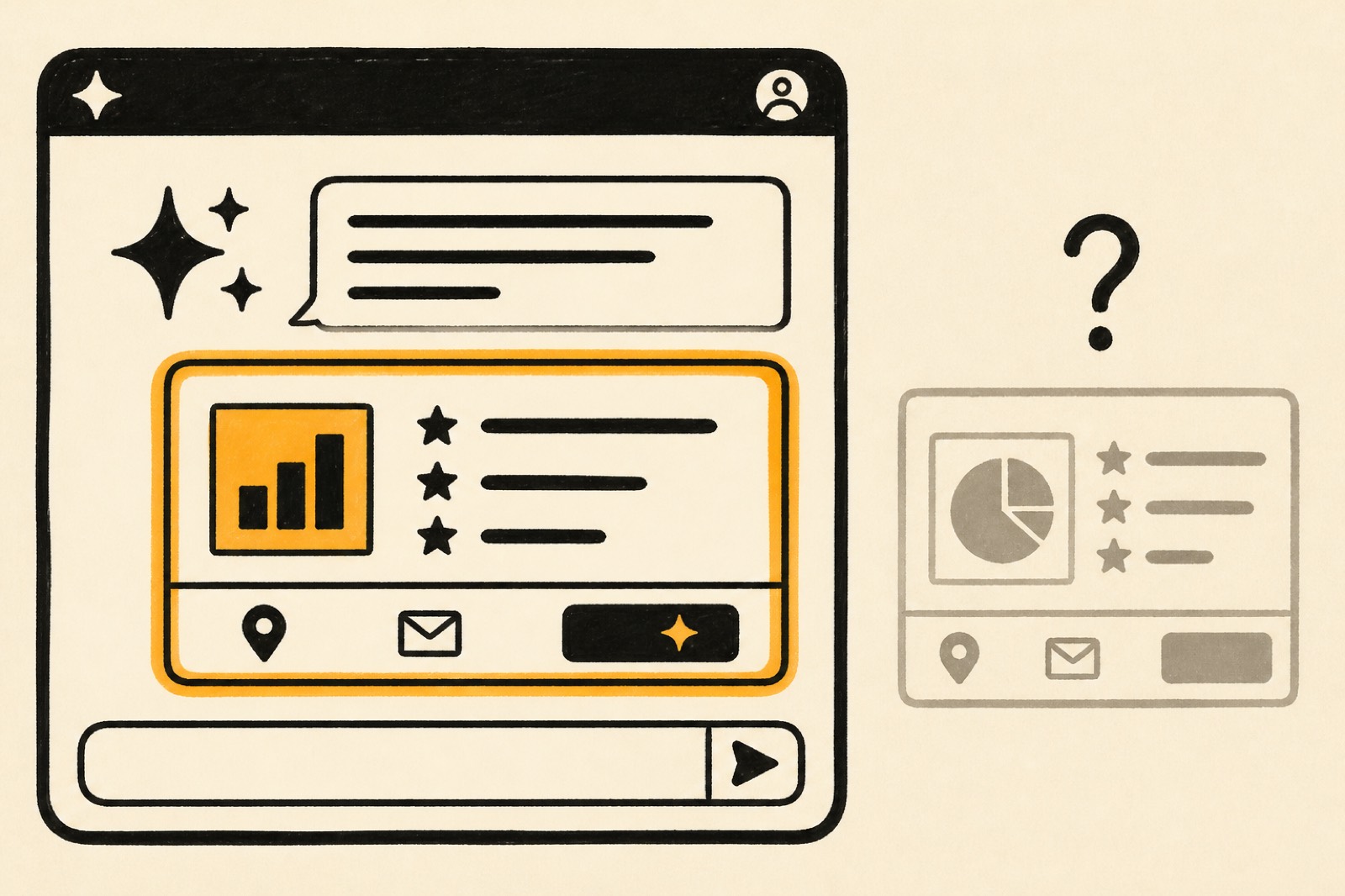
ChatGPT recommends your competitor because, for that question, their product is easier for it to reach, read, describe and verify. It isn't usually bias or payment. It's five signals: whether its crawler can get in, whether your pages answer plainly, whether you cover the buyer's sub-questions, whether your identity is consistent, and whether other sites vouch for you.
The competitor who keeps getting named
You know the moment. A prospect on a sales call says, "I asked ChatGPT for options and it gave me you, plus two others." You're relieved for half a second. Then you ask it yourself with slightly different wording, and you're gone. Your competitor is still there. The one with the worse product and the louder website.
The tempting reaction is to call the AI broken. I'd rather treat it like a tomato bed.
I garden, and every summer there's one plant on the end that out-produces the rest. It's the same variety, planted the same day. It just gets two more hours of sun and sits next to the hose. It's not a better plant. It's a better-placed plant. Your competitor is usually the same story. (Same seed, better spot.)
The good news about placement is that you can change it.
How ChatGPT picks the software it names
For buying questions, ChatGPT generally searches the web, reads a handful of passages and writes its answer from them. That has two consequences for your product.
First, one question becomes several lookups. Google describes its own AI features using "query fan-out," "issuing multiple related searches across subtopics and data sources" (Google Search Central), and AI search tools broadly work on the same principle. "Best invoicing software for agencies" turns into pricing, integrations, reviews and alternatives. If your competitor has a good answer for four of those lookups and you have one, they win the paragraph.
Second, the AI trusts other people's words about you more than your own. In Ahrefs' study of 75,000 brands, branded web mentions had the strongest correlation with appearing in Google's AI Overviews (0.664), while backlinks came in at 0.218 (Ahrefs). That's correlation, not a recipe, but it explains a lot of "how are they in here?"
Put plainly: the AI names what it can find, understand and check. So let's check.
The five signals: score yourself in an afternoon
This is the diagnostic we run before we touch a single page. Score each signal 0, 1 or 2, honestly. The lowest score is where you start.
| Signal | The garden version | The question to answer | 0 / 1 / 2 |
|---|---|---|---|
| 1. Crawlable | The gate is open | Can AI search crawlers reach and read your key pages? | Blocked / partly / fully |
| 2. Clear | The seed packet says what it is | Does each page answer its question in the first two sentences? | Vague / mixed / answer-first |
| 3. Covered | Every row is planted | Do you have a page for each sub-question buyers ask? | Homepage only / some / full map |
| 4. Consistent | The plant tags match | Is your one-line description the same everywhere? | Four versions / two / one |
| 5. Corroborated | The neighbors talk about your tomatoes | Do review sites, communities and press mention you? | Silent / thin / active |
A total under 5 usually means the AI genuinely can't recommend you with confidence. Between 5 and 8, you're in the mix but losing the close calls. Nine or ten and you're mostly fighting on product, which is where you want to be.
Now the detail on each, and how to test it.
1. Crawlable: is the gate locked?
This is the cheapest fix and the most common miss. OpenAI says "sites that are opted out of OAI-SearchBot will not be shown in ChatGPT search answers" (OpenAI). A lot of teams blocked every AI bot in robots.txt when the crawlers made headlines, and swept up the search crawler along with GPTBot, which is the one that gathers training data. Those are two separate choices. You can decline training and still allow search.
How to test it: open yoursite.com/robots.txt and search for OAI-SearchBot and GPTBot. Then ask your developer to confirm your firewall or CDN isn't blocking AI crawlers, and that your pricing and feature text appears in the raw HTML rather than only after JavaScript runs. A page that renders blank for a crawler is a garden bed behind a locked gate.
2. Clear: does your copy say anything quotable?
AI engines lift passages, not whole pages. If the first lines under a heading are "We help modern teams achieve more," there's nothing to lift. Your competitor's page that says "Ledgerly is invoicing software for agencies of 5 to 50 people, starting at $25 a month" gets quoted instead. (Ledgerly is made up. We'd rather not hold up a real company's homepage as the "before" picture.)
How to test it: take your homepage, pricing page and top two feature pages. Copy the first 50 words under each heading and paste them into a blank doc. If they don't make a complete, correct answer on their own, score yourself a 0 or 1.
3. Covered: are there empty rows in your garden?
This is where competitors most often beat better products. Fan-out means the AI checks the "pricing for small teams" row, the "integrates with QuickBooks" row and the "alternatives to the leader" row. Empty rows don't get picked.
How to test it: write down the five prompts your best buyers would type. Run each in ChatGPT, Perplexity and Gemini, and list every subtopic the answers touch. Then match each subtopic to a URL on your site and mark it covered, thin or missing. Count the misses. Comparison and alternatives pages are usually the biggest gap; we cover how to write fair ones that get quoted in comparison pages for AI search.
4. Consistent: do your plant tags match?
If your homepage calls you a "revenue platform," G2 files you under "sales engagement" and LinkedIn says "AI workflow automation," the AI sees three different plants in one pot and hedges. Your competitor, with the same boring sentence everywhere, gets described cleanly.
How to test it: ask ChatGPT, "What is [your product] and who is it for?" Wrong or blurry answers point to mismatched tags somewhere. Then write one sentence (product, category, buyer, result) and use it word for word on your site, review profiles, LinkedIn, Crunchbase and every bio.
5. Corroborated: are the neighbors talking?
This is the slow one, and it's often the real reason. Your competitor may simply have 300 reviews on G2 to your 14, a founder who answers questions on Reddit in their own name, and a few podcast appearances. The AI reads all of that.
How to test it: for each prompt you ran in step 3, note which sites the AI cited. After 20 or so prompts, the same handful of domains will keep appearing for your category. Mark which ones mention you. The gaps are your review, community and PR plan for the next two quarters.
Your competitor isn't standing still, so pick one fix
Here's the trap: you score yourself, find gaps in all five signals and try to fix everything in a sprint. Six weeks later, nothing's finished.
Do it in this order instead, which runs cheapest and fastest to slowest and most compounding:
- Open the gate (crawlable). Days, mostly a developer's time.
- Fix the tags (consistent). One sentence, an afternoon of logins.
- Rewrite the top pages answer-first (clear). A few weeks.
- Plant the missing rows (covered). A quarter of steady content.
- Work the neighborhood (corroborated). Ongoing.
If you want the full method behind each signal, it lives in the pillar guide, how to get your SaaS recommended by ChatGPT. If you're new to the whole idea, start with what AEO means for B2B software.
And if you'd like a second pair of eyes on your scorecard, book 30 minutes with me. We'll run your buyers' real prompts together and find out exactly why the other plant is getting the sun.
Here's to the better product getting the better spot. 🍻
Questions people ask next.
Is ChatGPT biased toward big brands?
It leans toward products it can verify, and big brands simply have more mentions, reviews and coverage to verify. That's an advantage, not a lock. Smaller products often win narrow, specific questions where they have clearer pages and the big brand is vague.
Can my competitor pay to be recommended in ChatGPT?
Not inside the answer. OpenAI says ads in ChatGPT are kept separate from answers, clearly labeled, and don't shape its responses (OpenAI Help Center). If a competitor shows up in the answer, they earned it through the signals above.
Why does ChatGPT give a different answer every time I ask?
AI answers vary from run to run and with small changes in wording, and each run may search and read slightly different sources. That's why one screenshot proves nothing. Track a fixed set of prompts monthly and read the trend.
How quickly can I start showing up instead of my competitor?
Crawl fixes can be picked up within weeks. Clearer pages and better coverage take one to three months to show. Reputation on review sites and communities takes longest, and it's usually what decides the close calls.
Founder of Cultre in Redding, California. Fifteen years building marketing for software companies and local businesses, and the one who'll be on your call.
Alex